
Pulse check on asset class performance year-to-date (YTD).
In Figure 1 we provide the YTD performance by key asset classes. Where possible, we express the asset class performance using an ASX-listed ETF (how most investors access it) rather than an index as performance can sometimes vary.

Some observations:
- Despite the U.S. dollar (USD) increasing this year, the broader commodities bucket (Bloomberg Commodities Index) is up almost +10%. Traditionally, a higher USD is negative for commodities. However, the YTD performance suggests that structural elements (securing supply of critical minerals in a growing multi-polar world) and inflation hedges (investors seeking commodities as a hedge against kinetic war) are driving commodities higher.
- The stronger USD did claim one commodity – gold – which is down almost -12% YTD. In our view, gold prices were driven lower not just by a strong USD, but also by a potentially hawkish U.S. Federal Reserve, as investor expectations shifted from rate cuts in 2026 to potential rate hikes in the U.S. during the first half.
- Within equities, Japan is again delivering strong double-digit returns. The main driver behind this performance is the global Artificial Intelligence (AI) buildout. Japan does not produce any of the AI models, but it provides the “picks and shovels” – equipment, testers and materials that make the chips. However, Japan is not just an AI story, the strength in stocks also comes from a pro-business government and the economy emerging from deflation after many decades.
- The other notable standout performer this year is Global REITs. However, our understanding is that most of the performance in “global” REITs is driven by performance in the U.S., likely due to the resilient economy and soft-landing narrative. Performance in ex-U.S. REITs was more mixed.
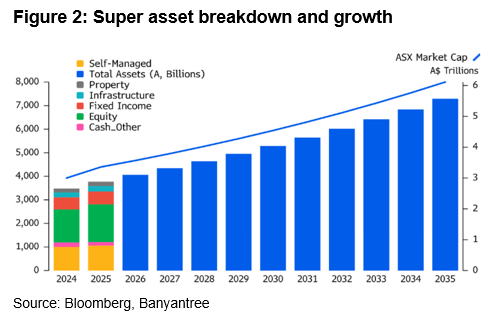
Australian super assets to climb to $6.0tr.
According to Bloomberg analysis, Australian super assets under management could potentially increase to $6.0tr by 2035, up from $3.8tr at the end of 2025. The Australian share market will be a direct beneficiary of this potential growth, with a reasonable portion likely finding its way into stocks. The chart below also explains why so many global fund managers and wealth management companies are looking to establish a presence in Australia. We think similar opportunities also exist in other jurisdictions, like the Middle East and Canada.