
SpaceX IPO
Right now you cannot escape the news flow surrounding SpaceX’s imminent IPO. In the background, both Anthropic and OpenAI have also “confidentially” filed for IPO as well. Google is proposing a massive $80bn equity raising. Meta (Facebook), feeling left out, is also now contemplating a major equity raise. What’s the rush?
We are reviewing SpaceX’s IPO prospectus and will form a view on the stock. In the meantime, we remain cautious about jumping into hot IPOs. In Australia, Guzman Y Gomez (GYG) is one we stayed well clear of – it came in hot at $15.20 on IPO day in 2024, PEAKED AT $45.32 and closed yesterday at $18.72. Happy to provide our thoughts on the blantant red flags we saw in that IPO offline for anyone that is interested – it will take 1:30 mins.
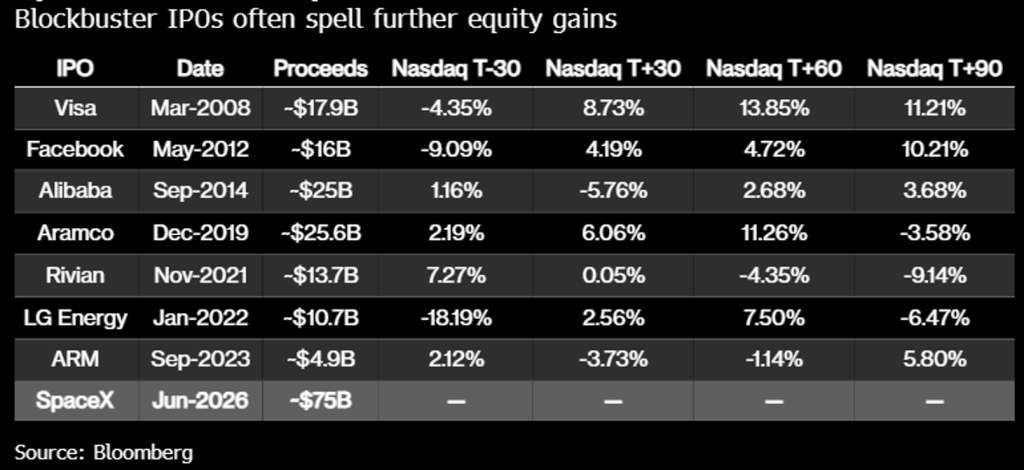
But perhaps Banyantree being cautious on “hot IPOs” is unreasonable and maybe just in our heads (“You got lucky with GYG”). Well the table below just landed on desks…timely… and appears our caution is warranted. These are all the “hot” IPOs in recent history and the data is conclusive (as long as the data is not hallucinating – need to put this caveat in these days!).

As a global equity portfolio manager, how do we play this mega IPO – at IPO or post listing we would take up a small position. Believe it or not, our initial view on the underlying company is not negative. Lots to like. By having skin in the game with such a mega IPO, it will mean we are not waking up every day and be fixated on one stock (it will drive markets for a little while) and we have not bet the house on it (well below our typical position size). Should the trend in “Hot IPOs” hold – as per the table below – and we remain comfortable with the underlying company, we would most definitely welcome a 55% drawdown to increase our position, all else being equal.
We would also look at the SpaceX IPO as potential buying opportunity for other tech names which investors may sell to take up allocation in the IPO. Opportunities could emerge in and around the IPO. SpaceX IPO will be fast tracked into the Nasdaq but S&P hasn’t bent its rules according to reports. If you look at just the largest IPOs over the past two decades (table below), the NASDAQ was higher on most occasions one month after. So, let’s not get too bearish!
Private Credit – Partners Group.
Private credit continues to make headlines. We have no investments in Private Credit – we have nothing against the sector, but we value liquidity (which not all investors frankly want or need).
We have said this since private credit started taking off – if markets crash we want to be able to take advantage of that crash and swiftly reallocate funds to risk (we rather have liquid alternatives for downside protection). At that point what we don’t want is to receive is an email stating what Partners Group recently sent: “We are writing to inform you that the 5.0% quarterly redemption limit for the Partners Group Global Value SICAV, the underlying fund of Partners Group Global Value Fund, has been reached in the second quarter of 2026.” Understanding your liquidity requirements is very important when going into any investments. Partners Group is well within their right to do this.
Although, there seem to be other concerns at Partners Group as well. A global research house published a note on Partners group questioning their valuation techniques – see below. Interestingly, I attended a Partners Group lunch in Sydney in 2023 and asked about their valuation methods from the back of the room. We undertake daily valuations across sectors, businesses and markets. We believe we have a fairly good handle on valuations. Anyway back then no one cared…I left lunch early…and here we are someone raising the question again…
Grizzly Research:
- We dug through the capital structure, underlying holdings, and national filings of Partner’s Group’s biggest evergreen funds, most prominently its Master Fund. We compared our findings to industry peers and consulted with industry experts, former Partners Group employees, and finance professors who expressed grave concern about our findings. One professor commented after reviewing our analysis carefully that the situation is “worse than Wirecard”.
- We found numerous instances where the Master Fund’s valuations did not reconcile with the reality of the underlying businesses. We estimate close to 40% of the evergreen funds’ investments might be severely mismarked.
- The Master Fund’s largest Asia-Pacific holding reports 50 million fewer shares of its key investment to the SEC than it reports to the Hong Kong Companies Registry.
- Partners Group’s Master Fund marked up a Russian pharmaceutical equity investment during the same reporting window in which the Russian state seized the asset by Putin’s decree.
- Often the timing of the investment, the financial performance of the operating companies, and valuation marks seem not to square up. These include a 176.9% markup on a Swedish data-center operator whose revenue fell 18% and operating losses widened 42% over the markup period; an 857.8% common equity markup on a Portuguese biocontrol group whose revenue grew 2.9% year-over-year; and a position whose common equity jumped 383% in 26 days.
- When we were able to back out valuation multiples relatively reliably, we arrived at the conclusion that Partners Group applies multiples for its own valuation that are far in excess of what industry comparisons suggest. Through financial gymnastics, Partners Group arrives at effective valuations that are sometimes more than twice as much as our independently commissioned valuation experts suggested.
- Across the Master Fund’s direct-debt book, reported principal balances moved in ways inconsistent with standard accounting. In many instances, principal value and fair value metrices moved not only by hundreds of percent and in different directions, which is very untypical for a senior loan.
- Partners Group tells investors its private-credit software exposure is “less than half the industry average.” We estimate its actual exposure in the available sample at 32%, which is above the industry average and more than heavily-criticized peers such as Blue Owl Capital.
- Importantly, we do not see the same irregular valuation patterns we saw in Partners Group in the filings of its largest US and European peers. We see attention to Partners Group’s evergreen funds and their valuation marks as a severe risk to the company’s fund-raising ability and long-term financial health
It’s not just Partners Group, other funds are also in the spotlight and investors are questioning what they actually hold…